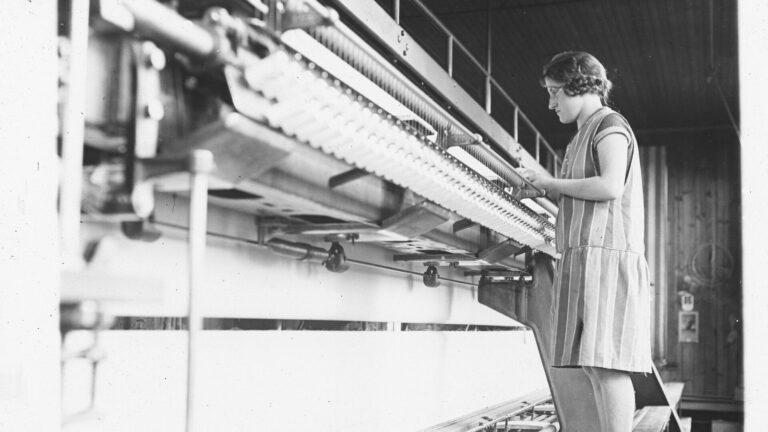

Zurich Silk Industry: 400 Years That Made the City Rich
Last updated: July 19, 2026.
The Zurich silk industry is the best story this city refuses to tell about itself. Every quiet grey coat on Paradeplatz has an ancestor, and the ancestor is a bolt of black taffeta. For roughly four centuries, Zurich wove, traded and shipped silk to the world — and in the 1850s and 1860s it was the second-largest silk producer on earth, behind only Lyon. Then the industry quietly dissolved into banks, buildings and habits, and the city moved on without a backward glance.
I find that silence very Zurich. Lyon built museums to its silk. Zurich built portfolios. But once you know the story, you cannot unsee it: the fabric-first instinct, the logo allergy, the dress codes — the whole personality of this city’s style reads differently when you know it was raised by silk merchants.
The city that wove before it banked
Silk shows up in Zurich’s records as early as the 14th century, which means the city was weaving before Switzerland existed in any form a modern person would recognise. That first chapter faded. The one that mattered began in the 16th century, and it began the way so many great textile stories do: with refugees.
Protestant families fleeing Catholic Locarno brought their trade north across the Alps. Among them was Hans Jacob Werdmüller, credited as the founder of Zurich’s silk industry in its enduring form. By the 17th century the trade was booming — not in factories, but scattered across thousands of farmhouse rooms, where families wove for city merchants through the putting-out system. The countryside supplied hands. The city supplied capital, patterns and ambition. That division of labour, frankly, still describes the canton.
Four hundred years in five taps
When Zurich was second only to Lyon
Between 1840 and 1900, silk was the most important processing industry in the canton. Raw silk arrived from China and Japan; finished fabric left for Paris, London and New York. A Zurich merchant named Caspar Baumann-Zürrer was selling Zurich taffetas out of New York by 1857. By around 1930, the Horgen firm Stünzi & Söhne ran a showroom in Manhattan. This was not a cottage curiosity. It was a global operation run from a city most of its customers could not find on a map.
Zurich’s two signature products tell you everything about the local temperament. The first was black taffeta — the most restrained luxury fabric imaginable, decades of craft invested in a colour that refuses to show off. The second will make you smile.
Besides dressing Europe in black taffeta, Zurich’s other world-famous silk product served every bakery on two continents. What was it?
In the 1880s, mechanical weaving mills spread along the left bank of Lake Zurich — Adliswil, Horgen, Thalwil, Hausen am Albis. The lake towns you now associate with commuter trains and property prices were once loud with looms. Here is the whole arc in one table.
| Period | What happened | Why it mattered |
|---|---|---|
| 14th century | First recorded silk work in Zurich | The craft enters the city’s bloodstream |
| 16th century | Protestant refugees from Locarno rebuild the trade | Werdmüller founds the industry’s enduring form |
| 17th century | First great boom; farmhouse weaving for city merchants | Countryside labour, city capital — the Zurich formula |
| 1840–1900 | Silk becomes the canton’s leading industry | World No. 2 after Lyon in the 1850s–60s |
| 1880s | Mechanical mills rise on the left lake shore | Adliswil, Horgen and Thalwil become factory towns |
| After 1930 | Steady decline begins | War, recession, imports and changing taste |
| 2011–2016 | The last two weavers move production abroad | Four centuries of weaving end quietly |

The dynasties that turned looms into banks
Here is my favourite part, and the part that explains modern Zurich best. The silk families did not vanish when silk faded. They changed products. The clearest case sits on the Limmatquai: in 1750, the merchants Caspar and Hans Conrad Schulthess opened a silk-trading house there. The securities side of the business grew, the silk side shrank, and by 1855 the firm had switched entirely to banking. Today it is Rahn+Bodmer, the oldest private bank in Switzerland. Its founding asset was thread.
Switzerland’s federal heritage inventory puts it plainly: the silk industry lives on through the banks, property companies and machine factories that grew out of it. Which is why I say, only half joking, that Paradeplatz is a silk district in disguise. The looms became ledgers. The lustre became discretion.
Fashion retail kept a thread too. In 1889, Adolf Grieder opened a silk house near the Fraumünster; Zurich nicknamed it Seiden-Grieder — Silk Grieder — and in 1913 it moved into the brand-new Peterhof on Paradeplatz. That building carried a silk shop’s name for over a century, and its successor store still trades on Bahnhofstrasse today. The street I keep writing about in my Bahnhofstrasse shopping guide is, at its roots, a silk merchant’s street.
| Silk-era name | What it was | What it became |
|---|---|---|
| Schulthess silk house, 1750 | Silk trading on the Limmatquai | Rahn+Bodmer — Switzerland’s oldest private bank |
| Seiden-Grieder, 1889 | Silk, lace and velvet house | Bongénie fashion store on Bahnhofstrasse |
| Stünzi & Söhne, Horgen | Silk weaver with a Manhattan showroom | Closed; its archives are part of the saved record |
| Heer & Co., Thalwil | Silk weaver whose fabric walked a 1951 Dior show | Gone, but stitched into couture history |
| Abraham / Gustav Zumsteg | Silk house beloved by Paris couture | “Soie Pirate” archive at the Swiss National Museum |
| Gessner & Weisbrod-Zürrer | The last two Zurich silk weavers | Production moved abroad in 2011 and 2016 |

Zurich silk in the couture spotlight
If the banking chapter is the quiet one, the couture chapter glitters. In 1951, silk from Heer & Co. of Thalwil appeared at a Dior show in Paris — a lake-town loom dressing the most famous fashion house on earth. And then there is Abraham, the Zurich silk firm led by Gustav Zumsteg, described as the most famous person of his time in Swiss textiles. When the company’s archive went to the Swiss National Museum in 2007, the resulting exhibition was called Soie Pirate. Pirate silk. Zurich, of all cities, produced fashion’s great silk buccaneer.
At its height, the industry counted more than 90 silk companies and over 12,000 weavers. Set those numbers against today and the scale of the disappearance becomes almost absurd.
The Zurich silk industry, then and now
Peak figures as reported by swissinfo; endpoint per the federal Living Traditions inventory.
How four centuries ended in two decades of quiet
Like every textile story in Europe, the Zurich silk industry ended slowly, then suddenly. The decline had no single villain. After 1930 the pressures stacked: the Second World War, the recession of the 1970s, foreign competition and shifting fashion tastes. Silk stopped being what a respectable wardrobe was made of. The mills on the left bank closed one by one, so gradually that nobody marked an ending — until 2011, when only Gessner and Weisbrod-Zürrer remained, and then 2016, when the last of the weaving itself moved abroad.
The arc of Zurich silk
A schematic curve drawn from the sourced milestones in this article — an illustration of the story, not a measured dataset.
Schematic relative scale of the industry: small in 1350, growing by 1650, near peak by 1850, peak around 1890, declining after 1930, marginal by 1980, ending by 2016.What saved the story from disappearing entirely was archival stubbornness. Over a dozen company archives were rescued: the textiles went to the Swiss National Museum, the papers to the State Archives of the Canton of Zurich, and since 2016 the Silk Memory portal has put the fabric designs online for anyone to study. The industry died; the evidence refused to.
Where to touch the silk city today
Once you start looking, the Zurich silk industry is everywhere in plain sight. This is where I would send you.
| Place | What you will find |
|---|---|
| Swiss National Museum, Zurich | The rescued silk textiles, including the Abraham / Soie Pirate archive |
| Zentralbibliothek Zürich | Exhibitions on 400 years of Zurich silk — sample books, trade albums, school textbooks |
| Silk Memory portal (online) | Thousands of digitised Zurich silk designs, free to browse |
| Peterhof, Paradeplatz | The 1913 building that housed Seiden-Grieder for over a century |
| Limmatquai | Where a 1750 silk house grew into Switzerland’s oldest private bank |
| Left-bank lake towns | Horgen, Thalwil, Adliswil — former mill towns of the 1880s boom |
And the living thread continues in the city’s fashion. enSoie — the name literally means “in silk” — carries Zurich’s silk sensibility into the present, which is exactly why it features in my guide to Swiss fashion designers worth knowing. The Zurich fashion scene never stopped being a textile scene. It just stopped saying so.
Why this history still dresses the city
Here is my honest conclusion. Zurich style — the fabric obsession, the horror of logos, the belief that quality should whisper — is not a trend this city adopted. It is an inheritance from people who spent four hundred years judging cloth between two fingers. When I write about quiet luxury in Switzerland, I am really writing about silk merchants’ great-great-grandchildren who kept the instincts and dropped the loom.
A city that made its first fortunes on black taffeta was never going to fall for a monogram. The loom became a bank, the bank became a dress code, and the dress code walks past you on Bahnhofstrasse every single day, dressed in navy, saying nothing about any of it. Now you know what it is not saying.
FAQ: Zurich silk industry
Why was the Zurich silk industry so important?
From 1840 to 1900 the Zurich silk industry was the most important processing industry in the canton, and in the 1850s and 1860s Zurich was the world’s second-largest silk producer after Lyon. At its height it counted more than 90 companies and over 12,000 weavers, exporting to Paris, London and New York.
What was Zurich silk famous for?
Two things above all: black taffeta, the most restrained of luxury fabrics, and bolting cloth — fine silk gauze used worldwide to sift flour. Later, Zurich houses like Abraham supplied Paris couture, and Thalwil-woven silk appeared at a Dior show in 1951.
Does the Zurich silk industry still exist?
Not as a weaving industry, no. After decades of decline, the last two Zurich silk weavers, Gessner and Weisbrod-Zürrer, moved production abroad in 2011 and 2016. The heritage survives in archives, museums, the online Silk Memory portal — and in businesses that grew out of silk, including banks.
How is Zurich’s silk history connected to its banks?
Directly. Switzerland’s oldest private bank, Rahn+Bodmer, began in 1750 as the Schulthess silk-trading house on the Limmatquai and switched fully to banking by 1855. The federal heritage inventory notes that banks, property firms and machine factories grew out of the silk sector.
Where can I see Zurich silk today?
Start with the Swiss National Museum for the rescued textiles, the Zentralbibliothek’s silk exhibitions, and the free Silk Memory portal online. Then walk it: the Peterhof on Paradeplatz housed the Seiden-Grieder silk house for a century, and the left-bank lake towns were the mill belt of the 1880s.